KEV Catalog Basics and Usage
Published: August 27, 2026
Introduction
A large number of CVEs are published, and treating every one of them with the same priority is not practical.
The KEV Catalog, published by the U.S. Cybersecurity and Infrastructure Security Agency (CISA), helps identify vulnerabilities that are being used in real-world attacks.
This article explains what KEV means, the criteria for adding a vulnerability to the KEV Catalog, the data the catalog provides, and how to use it in vulnerability management.
What is KEV?
KEV stands for Known Exploited Vulnerabilities.
KEV is not a new identifier for a vulnerability. It refers to vulnerabilities that have been confirmed as exploited in real-world attacks.
What is the KEV Catalog?
The U.S. Cybersecurity and Infrastructure Security Agency (CISA) maintains the Known Exploited Vulnerabilities Catalog (KEV Catalog), which lists vulnerabilities confirmed as exploited in real-world attacks.
The KEV Catalog contains vulnerabilities that have a CVE ID and for which there is reliable evidence of exploitation. Entries are organized by CVE ID and include information such as the affected product and the required action.
Organizations can use the catalog to identify which CVEs already represent a real-world threat and prioritize their response accordingly.
The KEV Catalog is available through CISA in the following formats:
The web page can be searched by CVE ID, product name, or vendor name. The JSON and CSV files can be imported into vulnerability management tools or matched automatically against scanner results.
The relationship between CVE and the KEV Catalog can be summarized as follows:
| Item | CVE | KEV Catalog |
|---|---|---|
| Primary purpose | Identify a vulnerability with a common ID | Identify vulnerabilities exploited in real-world attacks |
| Scope | Publicly disclosed vulnerabilities in general | CVEs that meet the catalog's inclusion criteria |
| Managed by | CVE Program | CISA |
| What it tells you | Which vulnerability is being discussed | Whether exploitation in real-world attacks has been confirmed |
The catalog adds the information that exploitation has been confirmed to an existing CVE.
Criteria for inclusion in the KEV Catalog
CISA specifies three criteria for adding a vulnerability to the KEV Catalog:
- The vulnerability has an assigned CVE ID.
- There is reliable evidence that the vulnerability has been actively exploited.
- There is a clear remediation action for the vulnerability.
A vulnerability must meet all three criteria to be considered for inclusion.
1. The vulnerability has an assigned CVE ID
Because the KEV Catalog is organized around CVEs, a vulnerability must have a CVE ID.
Even when a vulnerability is being exploited, it does not meet the catalog's criteria until a CVE ID has been assigned.
2. There is evidence of active exploitation
CISA's definition of active exploitation includes not only successful exploitation but also attempts by an attacker to exploit a vulnerability in a real-world environment. Potential evidence includes:
- Logs or forensic information from a compromised system
- Exploitation attempts observed by a honeypot or similar system
- Use by malware or ransomware
- Attacks confirmed by a vendor or security company
- Records showing that an attacker sent or executed exploit code against a target system
The following information alone is not treated as evidence of active exploitation:
- A proof of concept (PoC) has been published
- A researcher reproduced the vulnerability in a test environment
- Scanning for vulnerable systems has been observed
- The vulnerability is considered technically exploitable
A published PoC is important because it can increase the risk of future exploitation. By itself, however, it does not prove that an attacker exploited the vulnerability in a real-world environment.
CISA evaluates evidence from sources such as incident response activities, government agencies, product vendors, security companies, and researchers. Information about affected organizations or the specific evidence may not be published because of confidentiality or source-protection concerns.
3. There is a clear remediation action
For a vulnerability to be added to the KEV Catalog, there must also be a specific action that affected organizations can take. Examples include:
- Updating to a fixed version
- Applying a vendor-provided patch
- Disabling the affected feature or service
- Mitigating the issue through configuration changes or access restrictions
- Applying a vendor-provided workaround
- Discontinuing or replacing the product when no effective mitigation is available
General advice such as "use caution" or "increase monitoring" is not a specific procedure for fixing or mitigating a vulnerability. Users must be given a clear action to perform.
How to nominate a vulnerability
Anyone can report a candidate for inclusion in the KEV Catalog to CISA, not only product vendors and security companies.
Use "Nominate a New KEV" on the KEV Catalog page to submit the candidate vulnerability and evidence of exploitation.
Submission does not guarantee that the vulnerability will be added. CISA reviews the information, conducts further investigation when necessary, and adds the vulnerability only if it determines that all inclusion criteria are met.
Nominating a vulnerability for the KEV Catalog is also different from requesting a CVE ID for a new vulnerability. If the vulnerability does not yet have a CVE ID, one must first be assigned through the appropriate CNA or another CVE Program process.
Key data fields in the KEV Catalog
The JSON feed contains catalog-level metadata and an array of vulnerability entries. Its structure can be simplified as follows:
{
  "title": "CISA Catalog of Known Exploited Vulnerabilities",
  "catalogVersion": "...",
  "dateReleased": "...",
  "count": 0,
  "vulnerabilities": [
    {
      "cveID": "CVE-YYYY-NNNN",
      "vendorProject": "Example Vendor",
      "product": "Example Product",
      "vulnerabilityName": "Example Vulnerability",
      "dateAdded": "YYYY-MM-DD",
      "shortDescription": "...",
      "requiredAction": "...",
      "dueDate": "YYYY-MM-DD",
      "knownRansomwareCampaignUse": "Unknown",
      "notes": "...",
      "cwes": ["CWE-NNN"]
    }
  ]
}
The main fields for each vulnerability are:
| Field | Description |
|---|---|
cveID |
CVE ID |
vendorProject |
Vendor or project name |
product |
Affected product |
vulnerabilityName |
Vulnerability name |
dateAdded |
Date added to the KEV Catalog |
shortDescription |
Vulnerability summary |
requiredAction |
Required action |
dueDate |
Remediation deadline for U.S. federal civilian executive branch agencies |
knownRansomwareCampaignUse |
Whether use in ransomware campaigns is known |
notes |
References such as vendor information |
cwes |
CWE identifiers describing the type of vulnerability |
The dueDate is a deadline for U.S. federal civilian executive branch
agencies. It does not by itself impose a legal obligation on individuals or
private-sector organizations, although it can be useful when assessing the
urgency of a response.
How to use the KEV Catalog
The basic workflow is to determine whether a CVE detected in your environment appears in the KEV Catalog, then use the catalog entry and the vendor's official information to decide how to respond.
The following example walks through a manual review after a vulnerability
scanner detects CVE-2021-44228.
Step 1: Confirm the detected CVE ID
Confirm the CVE ID in the vulnerability scanner results. In this example, the
scanner has detected CVE-2021-44228, an Apache Log4j2 vulnerability.
Step 2: Search for the CVE ID in the KEV Catalog
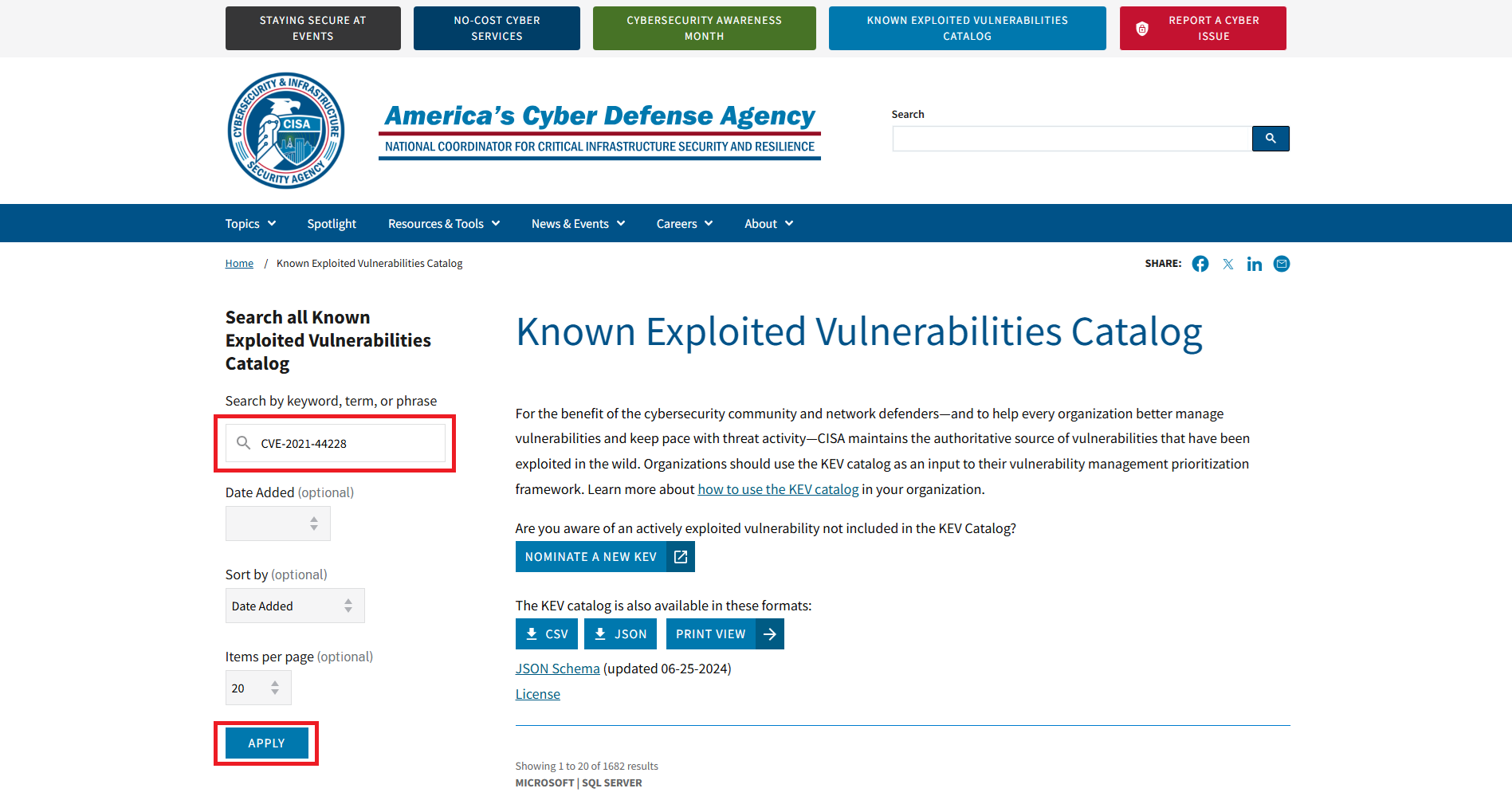
Open CISA's KEV Catalog,
enter CVE-2021-44228 in "Search by keyword, term, or phrase," and select
"APPLY."
Step 3: Review the KEV Catalog entry
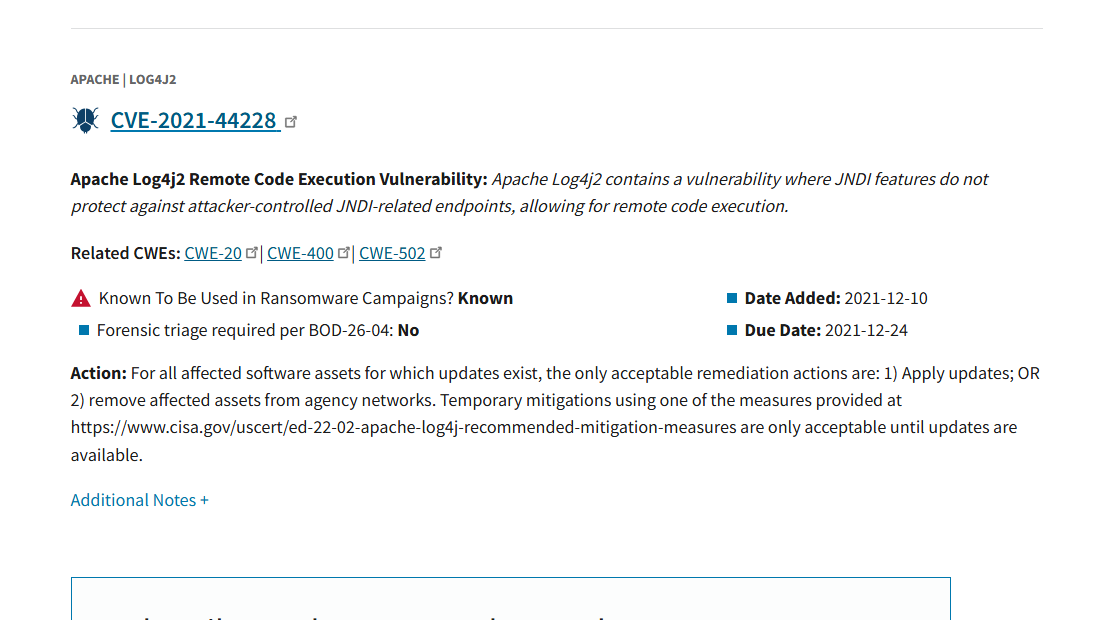
If CVE-2021-44228 appears in the results, the vulnerability is included in
the KEV Catalog.
The result identifies the vendor and product as "Apache | Log4j2" and provides a vulnerability summary, the date it was added to the catalog, and the remediation deadline for U.S. federal agencies. "Known To Be Used in Ransomware Campaigns" is set to "Known," indicating that its use in ransomware campaigns has been confirmed.
Step 4: Review CISA's required action
The "Action" field in the search result describes the response required by
CISA. For CVE-2021-44228, affected assets for which updates exist must be
updated or removed from agency networks. The entry also refers to temporary
mitigations that may be used until updates are available.
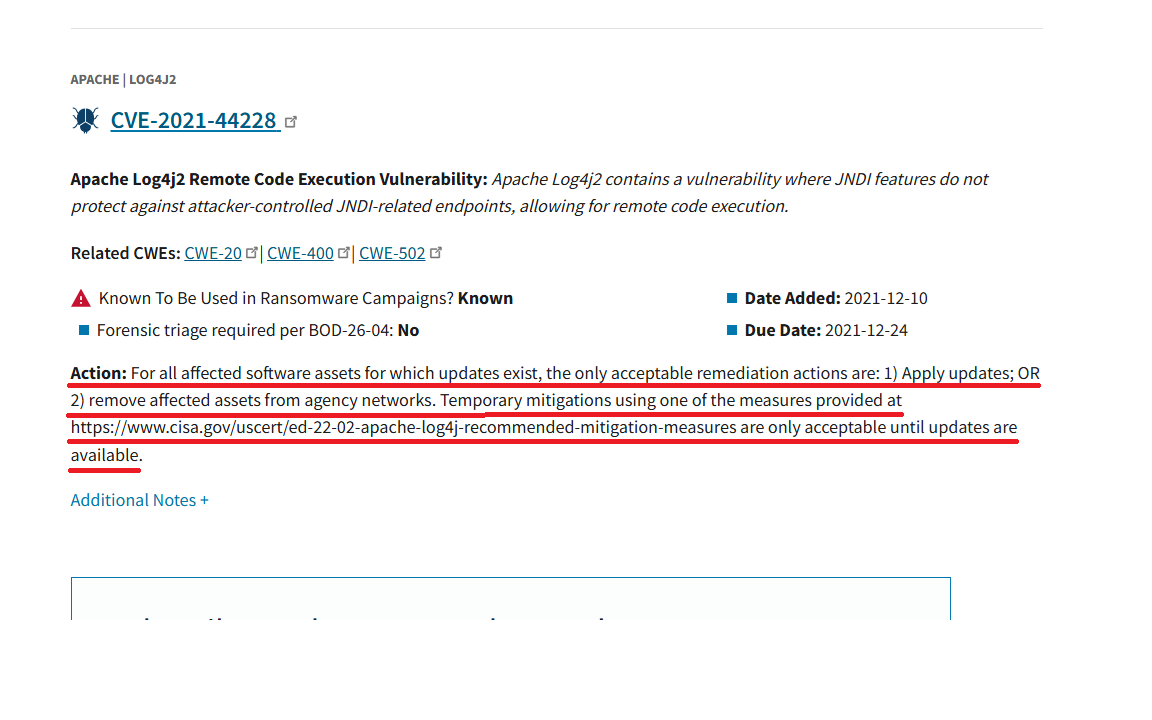
The KEV Catalog's "Action" field provides a response policy. To determine the affected versions and the specific version to install, also consult the product vendor's official information.
Step 5: Check the vendor's official information for affected and fixed versions
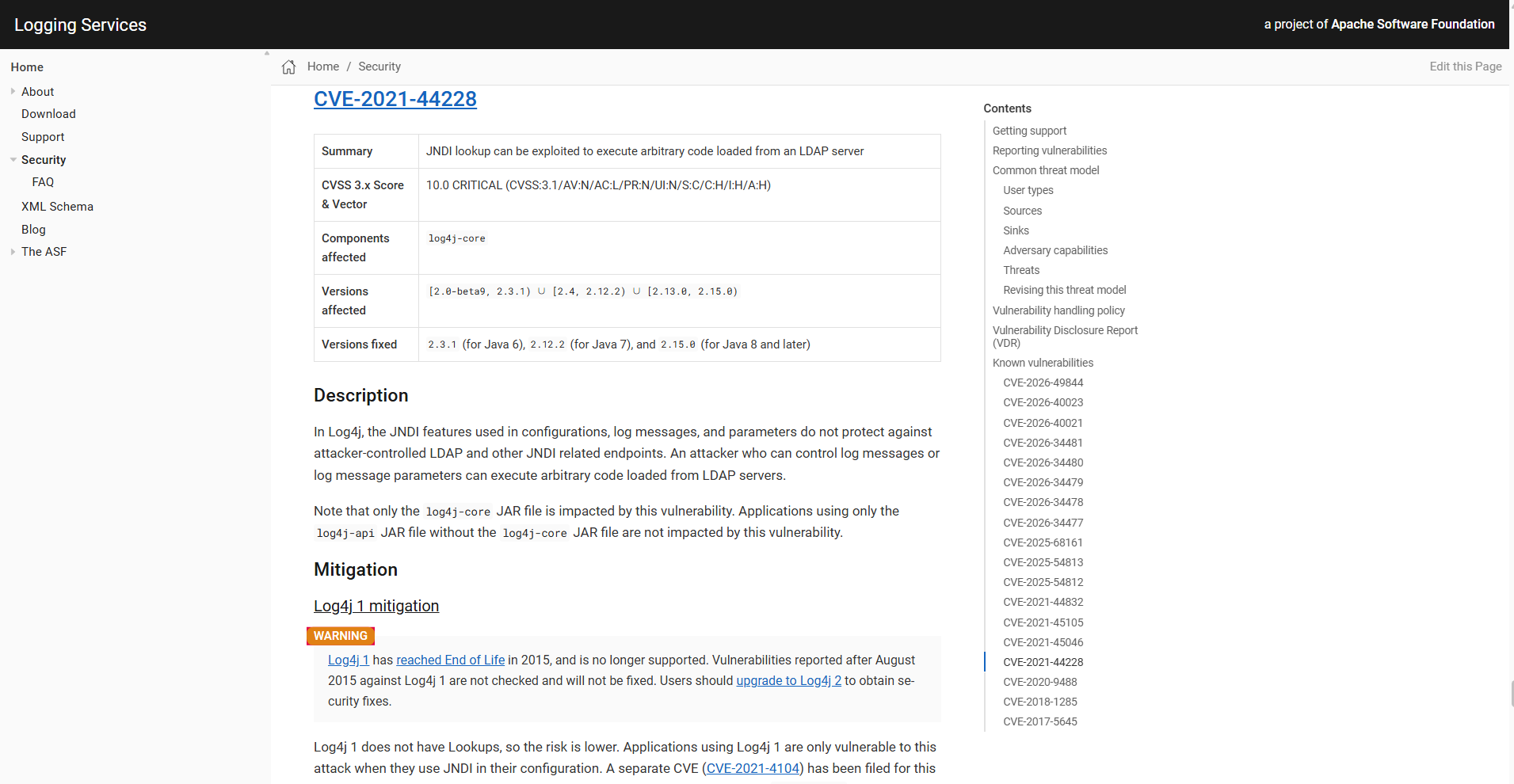
For this example, consult the Apache Logging Services security page published by the Apache Software Foundation, which develops the product. This page was not reached directly through "Additional Notes" in this KEV Catalog entry. It is vendor information located separately by using the product name and CVE ID shown in the search result.
The Apache page identifies the affected component and versions, fixed versions, and mitigations. Compare this information with the version and configuration in your environment. If your environment is affected, update the product or apply the necessary mitigation.
For automated use, download the JSON or CSV feed from CISA and match its CVE IDs against those reported by a vulnerability scanner. When a CVE appears in the KEV Catalog, its confirmed exploitation can be used to raise the priority of alerts and remediation.
Important considerations when using the KEV Catalog
Absence from the KEV Catalog does not mean a vulnerability is safe
A vulnerability may be absent from the KEV Catalog for reasons other than a lack of exploitation:
- CISA may not yet be aware of the exploitation
- The reliability of the evidence may still be under review
- A CVE ID or a clear remediation action may not yet exist
- Future exploitation may be possible even though none has been confirmed
Therefore, vulnerabilities not listed in the KEV Catalog should not be ignored.
The KEV Catalog does not determine whether your environment is affected
Inclusion in the KEV Catalog means that exploitation of the CVE has been confirmed. It does not determine whether your particular environment is affected.
Even when the same product is in use, the impact can depend on its version, configuration, enabled features, and exposure to the internet. The final determination requires checking the vendor advisory and the state of your own environment.
Summary
The KEV Catalog has the following characteristics:
- It is a CISA-maintained list of vulnerabilities exploited in real-world attacks.
- An entry must have a CVE ID, evidence of exploitation, and a clear remediation action.
- A published PoC or scanning for vulnerable devices alone is not evidence of exploitation.
- Anyone can nominate a candidate vulnerability to CISA.
- The catalog is available as a web page and in JSON and CSV formats.
- Matching the catalog against scanner results helps prioritize remediation.
- Absence from the KEV Catalog does not mean that a vulnerability is safe.
Where CVE provides a common ID for identifying a vulnerability, the KEV Catalog helps determine whether that vulnerability has been used in real-world attacks.
When a large number of vulnerabilities compete for attention, the KEV Catalog is a useful source for prioritization. It should not be used in isolation; consider the impact on your environment, CVSS, EPSS, and the availability of a fix as well.
References
The following sources were reviewed on August 27, 2026.
- CISA: Known Exploited Vulnerabilities Catalog
- CISA: Reducing the Significant Risk of Known Exploited Vulnerabilities
- CISA: KEV Catalog JSON
- CISA: KEV Catalog CSV (GitHub mirror)
KestreLynx is open-source software that regularly scans images used by running Docker and Kubernetes containers with Trivy and sends changes since the last scan and priorities based on severity, CISA KEV, and EPSS to Slack or a webhook. For Docker and Compose, remediation plans and pull requests (experimental) support remediation from comparing update candidates to creating GitHub pull requests, with both features disabled by default. Users handle merging, rebuilding, and deployment.